Diagram template
Cycle: stage ledger
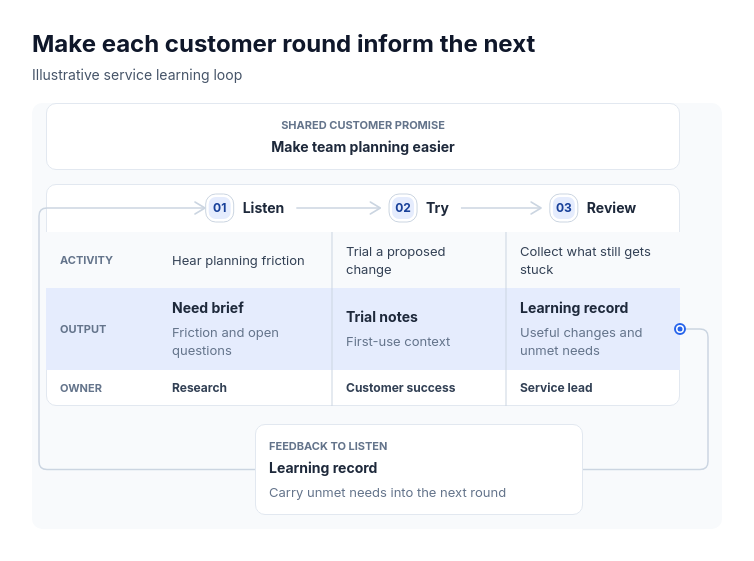
PowerA labeled shared goal spans an ordered stage ledger with activity, exact produced work and accountable owner rows; the final stage's output returns to the first stage on a separate feedback rail.
Categories
Included in
Power, Max
When to use it
For 3–5 stage recurring loops with named owners, produced work and an explicit final-to-first feedback artifact: customer learning loops, hiring or onboarding routines, editorial cycles, release reviews and continuous-improvement rounds. Stage spacing is schematic; evidence must be supplied or visibly illustrative. Not for one-off linear processes, invented observed findings, measured rates or guaranteed outcomes.
Adjust after generating
Change the style, colors, and font, and these options, as often as you like without spending credits.
- Card shape
- Card fill
- Card border
- Card shadow
- Material
- Typography
- Spacing
- Icon shape
- Icon fill
- Icon shell
- Connectors
- Line weight
What you fill in
Describe your topic in plain words and the AI fills these in. You can edit every field afterwards.
- Center
- Text
- Center label
- Text
- Stages
- 3 to 5, each with id, title, description, and owner
- Outputs
- 3 to 5, each with id, stage, title, and description
- Edges
- Exactly 1, each with from, to, and label
Related templates
All cycle templates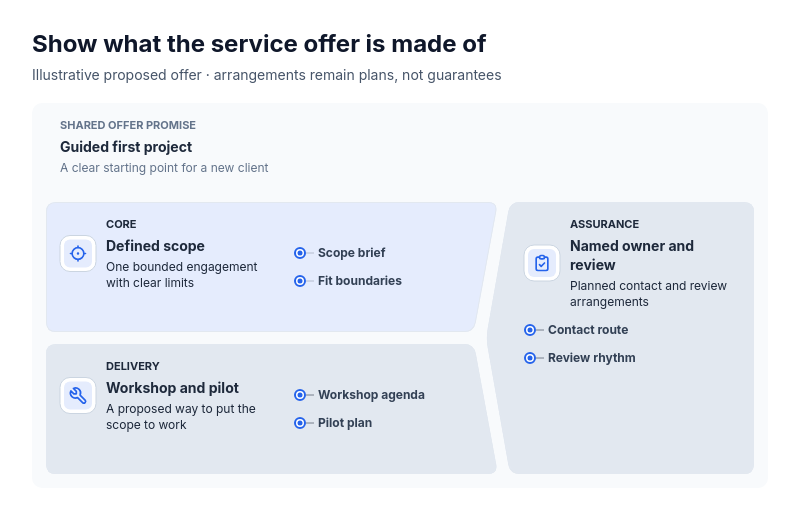 Anatomy: crowned subjectFor explaining what one thing is made of as a primary part, the part that carries it out and a part that spans both: a service offer (scope, delivery, assurance), a product (core function, how it ships, support), a course (content, format, learner support), an event (program, logistics, hosting) or a team charter (mission, ways of working, backing).
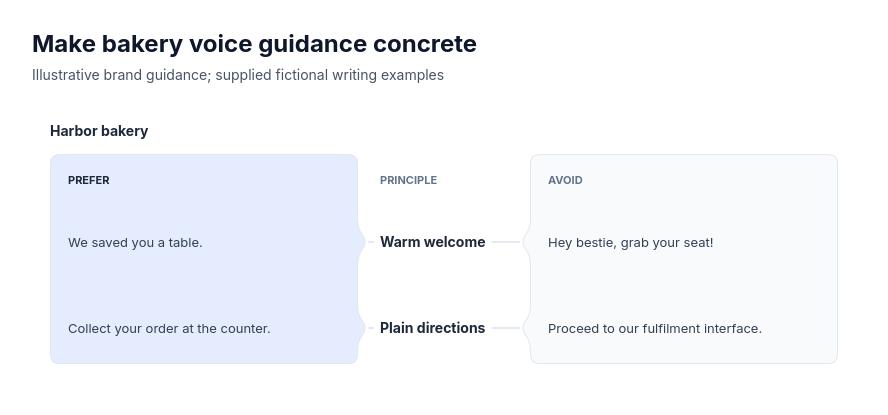 Comparison: principle seamsFor two to four supplied principles, each owning one exact preferred example and one exact example to avoid: brand voice guides, product interface copy, support reply standards, documentation style, naming conventions, inclusive language or meeting etiquette.
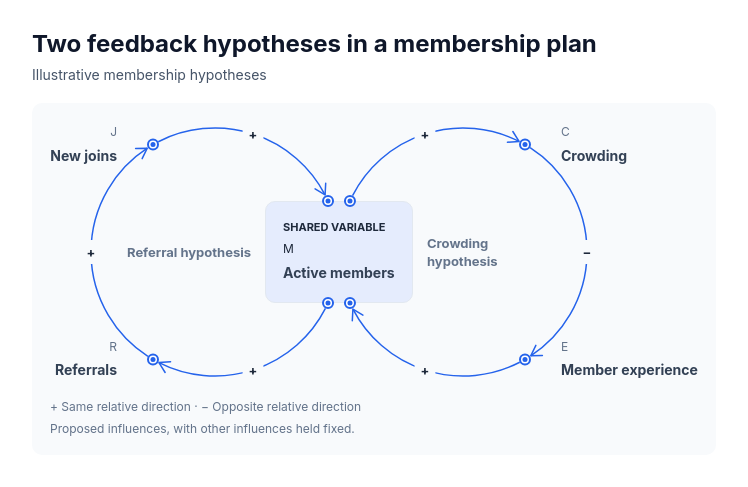 Cycle: causalFor a compact qualitative causal-loop view with exactly five variables and two three-link loops sharing one variable: a referral loop against crowding in a membership plan, workload against hiring in a team, adoption against support load in a product, or demand against price in a market.
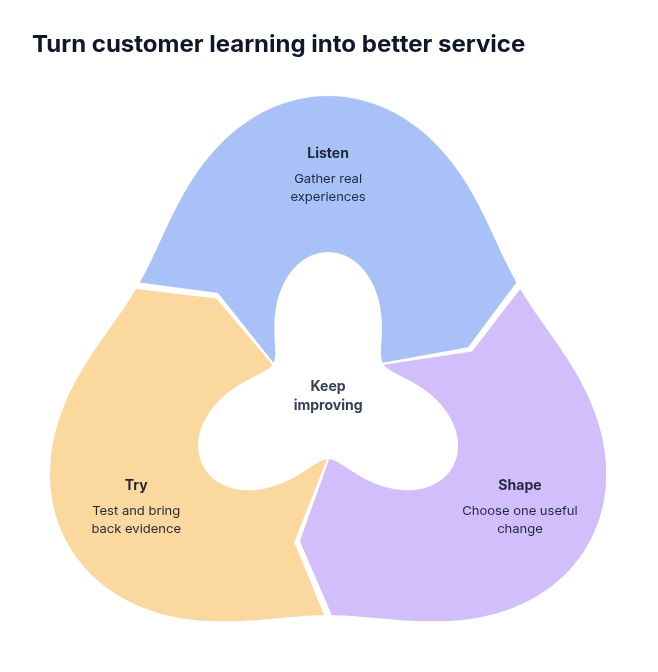 Cycle: clover contourThree-phase improvement rhythms, creative iteration or learning cycles.
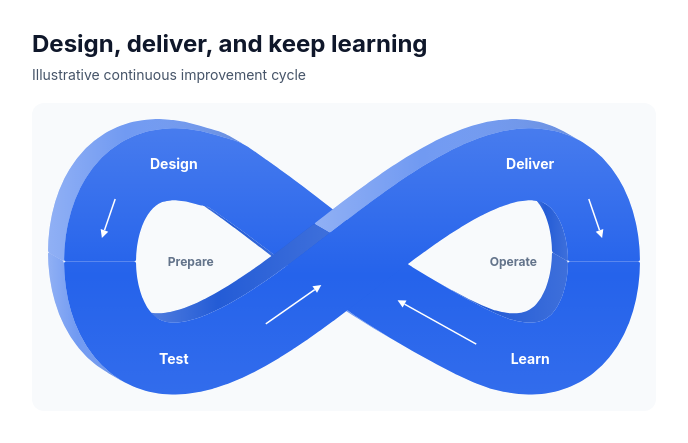 Cycle: dimensional infinityOne ordered four-stage process repeating through two phases, two stages per phase.
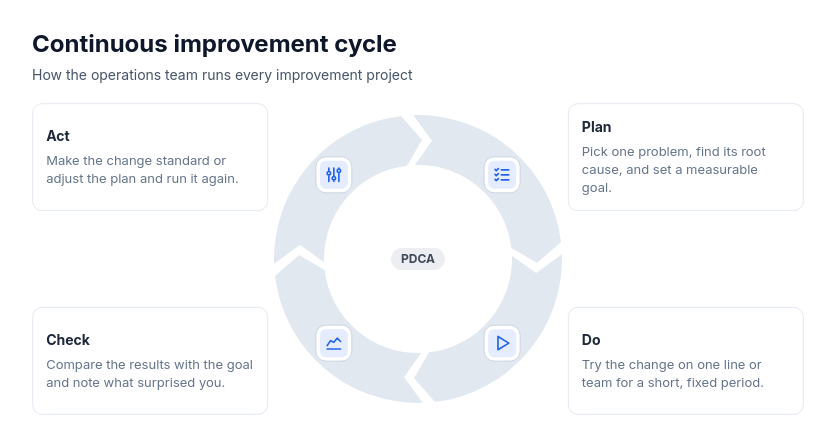 Cycle: donut of arrow segmentsThree to six phases that repeat in a loop, such as plan-do-check-act, a software or product lifecycle, a customer or sales cycle, or a data lifecycle.